
Low Tide
1927
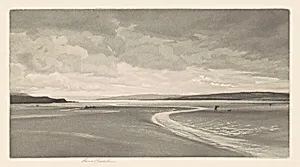
Medium
aquatint in black on wove paper
Dimensions
plate: 18.9 × 35.2 cm (7 7/16 × 13 7/8 in.) sheet: 31.6 × 46.9 cm (12 7/16 × 18 7/16 in.)
Classification
Department
CG-W
Museum
National Gallery of Art, Washington, D.C.
Credit
Corcoran Collection (Bequest of Frank B. Bristow)
Accession Number
2015.143.137
Rights
Public Domain
Art Historical Context
**Low Tide** (1927) by Percival Gaskell captures the serene beauty of a receding shoreline in this exquisite aquatint print. Gaskell, a prominent British printmaker of the early 20th century, was renowned for his mastery of intaglio techniques, particularly aquatint, which he used to evoke the subtle moods of coastal landscapes. Created during the interwar period, when British artists embraced printmaking as an accessible medium for naturalistic scenes, this work reflects the era's fascination with nature's quiet drama. Aquatint, a variant of etching, involves dusting resin on a metal plate and immersing it in acid to create rich, tonal gradations resembling watercolor washes. Gaskell's precise control produces velvety blacks and soft transitions in **Low Tide**, highlighting the exposed sands and lingering pools at ebb tide on wove paper (plate: 18.9 × 35.2 cm). This technique was revolutionary for prints, allowing atmospheric depth without color, making it ideal for intimate gallery viewing. Now part of the National Gallery of Art's Corcoran Collection (Bequest of Frank B. Bristow), **Low Tide** exemplifies the etching revival's legacy. Visitors will appreciate its meditative calm—a timeless invitation to ponder the rhythm of sea and shore. (198 words)