
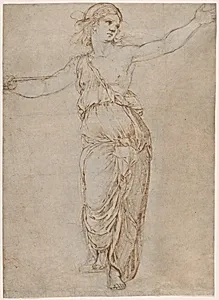
Lucretia
Medium
Pen and brown ink over black chalk, partially incised with a stylus (recto); rubbed with black chalk for transfer (verso)
Dimensions
15-5/8 x 11-1/2 in. (39.7 x 29.2 cm)
Classification
Drawings
Department
Drawings and Prints
Museum
Metropolitan Museum of Art, New York, NY
Credit
Purchase, Lila Acheson Wallace Gift, 1997
Accession Number
1997.153
Rights
Public Domain
Tags
Art Historical Context
Raphael’s *Lucretia* captures the Roman heroine at a moment of profound resolve, her figure rendered with the graceful poise and balanced proportions that define the artist’s High Renaissance style. Created between 1508 and 1510 while Raphael was active in Rome, the drawing reflects the period’s renewed fascination with classical antiquity and moral exemplars from ancient history. Lucretia’s story—her tragic choice to preserve honor after assault—resonated deeply in Renaissance culture as a symbol of virtue and republican ideals. Executed in pen and brown ink over black chalk, the sheet reveals Raphael’s working process. The stylus incisions and the verso rubbed with black chalk indicate the drawing was prepared for transfer, likely serving as a model for an engraving or larger composition. This economical yet precise technique allowed the artist to refine contours and convey both the weight of drapery and the quiet strength of the figure within a compact format. Today housed in the Metropolitan Museum of Art’s collection of drawings and prints, the work offers visitors an intimate glimpse into Raphael’s studio practice and the enduring cultural power of Lucretia’s narrative.