
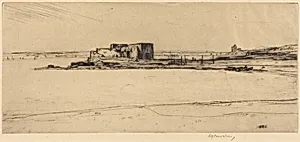
Lunan Bay
Medium
etching and drypoint on laid paper
Dimensions
plate: 11.2 × 25.5 cm (4 7/16 × 10 1/16 in.) sheet: 18.2 × 32.3 cm (7 3/16 × 12 11/16 in.)
Classification
Department
CG-W
Museum
National Gallery of Art, Washington, D.C.
Credit
Rosenwald Collection
Accession Number
1943.3.2474
Rights
Public Domain
Art Historical Context
David Young Cameron's *Lunan Bay* (1911) captures the rugged beauty of Scotland's Angus coastline in a masterful etching and drypoint on laid paper. Cameron, a leading Scottish artist of the early 20th, was renowned for his topographical etchings that blended precise observation with atmospheric drama. This intimate plate (11.2 × 25.5 cm) evokes the vast sweep of Lunan Bay's sands and dunes under a moody sky, inviting viewers to feel the North Sea's wild energy. Etching allowed Cameron to incise fine lines into a copper plate with acid, while drypoint added velvety burrs for rich textures—techniques that elevated printmaking during Britain's etching revival. Printed on traditional laid paper, which reveals its chain lines, the work exemplifies the medium's intimacy and reproducibility, making fine art accessible to collectors. Housed in the National Gallery of Art's Rosenwald Collection, it highlights Cameron's skill in transforming landscape into poetry. This piece reflects Edwardian-era fascination with Britain's natural heritage amid rapid industrialization, offering a timeless escape into Scotland's elemental allure.
About the Artist
David Young Cameron · 1865–1945
Sir David Young Cameron (1865-1945) was a Scottish painter and etcher who achieved international recognition primarily for his atmospheric etchings of architectural and landscape subjects. Born in Glasgow during the Victorian era, Cameron became one of Britain's most celebrated printmakers, eventually receiving a knighthood and serving in prominent positions including Trustee of the Tate Gallery a...