
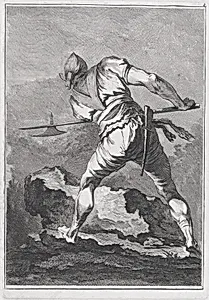
Lunging Soldier Seen from Behind
Medium
Etching
Dimensions
Sheet: 18 1/16 × 11 11/16 in. (45.8 × 29.7 cm)
Classification
Prints
Department
Drawings and Prints
Museum
Metropolitan Museum of Art, New York, NY
Credit
The Elisha Whittelsey Collection, The Elisha Whittelsey Fund, 2018
Accession Number
2018.54.8
Rights
Public Domain
Tags
Art Historical Context
In the Metropolitan Museum of Art's Drawings and Prints department, *Lunging Soldier Seen Behind* (1764) captures a dynamic moment of martial intensity through the etching techniques of Philippe Jacques de Loutherbourg and Matthias Pfen. Loutherbourg, a French-born artist who later thrived in England, was renowned for his vivid battle scenes and innovative use of light, often blending history painting with dramatic realism. Pfenninger, likely a skilled collaborator in printmaking, contributed to this large-scale sheet (18 1/16 × 11 11/16 in.), emphasizing the soldier's powerful lunge viewed from behind, sword or weapon poised in action. Etching, an intaglio process where acid etches lines into a metal plate for inked impressions, allowed for intricate details in the figure's musculature, armor, and motion—hallmarks of 18th-century printmaking that made art accessible beyond paintings. Created shortly after the Seven Years' War, this work reflects Europe's fascination with military valor and discipline, common in period illustrations for training manuals or heroic narratives. Part of The Elisha Whittelsey Collection, this print invites visitors to ponder the human form in combat, blending technical precision with raw energy, a testament to the era's evolving graphic arts.
About the Artist
Philippe Jacques de Loutherbourg|Matthias Pfenninger · 1740–1812
Philippe Jacques de Loutherbourg, born in Strasbourg in 1740 to a Swiss miniaturist and engraver, initially pursued studies at the University of Strasbourg for the Lutheran ministry before turning decisively to art. In 1755, he moved to Paris, where he studied under the history painter Charles-André van Loo and the battle specialist Francesco Giuseppe Casanova, later training with engraver Jean-Ge...