
Lupercalia (recto), and Sketches of Figures (verso)
n.d.
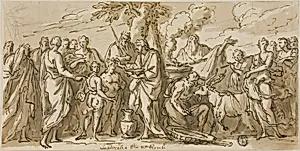
Medium
Pen and brown ink, with brush and brown wash, over graphite (recto), and black chalk (verso), on ivory wove paper
Dimensions
12.7 × 25.1 cm (5 × 9 15/16 in.)
Classification
pen and ink drawings
Department
Prints and Drawings
Museum
Art Institute of Chicago
Accession Number
112571
Rights
Public Domain
Art Historical Context
James Thornhill, a leading British Baroque artist of the early 18th century, is celebrated for his grand history paintings and decorative schemes adorning landmarks like St. Paul's Cathedral and the Painted Hall at Greenwich. This undated double-sided drawing, *Lupercalia (recto), and Sketches of Figures (vers)*, showcases his mastery of classical themes. On the recto, the depiction of Lupercalia—an ancient Roman fertility festival honoring the god Faunus with ritual processions, sacrifices, and youthful revelry—evokes the pagan energy of antiquity, a popular subject for Baroque artists drawing from mythological sources. Crafted on ivory wove paper, a fine 18th-century support prized for its smooth texture, the recto combines graphite underdrawing with precise pen and brown ink lines, heightened by brush and brown wash for dramatic modeling and depth. This layered technique allowed Thornhill to explore composition and light with fluidity, typical of preparatory studies for larger oil paintings or frescoes. The verso's quick black chalk sketches of figures reveal his spontaneous approach to anatomy and pose, offering glimpses into his creative process. Housed in the Art Institute of Chicago's Prints and Drawings collection, this intimate 12.7 × 25.1 cm sheet (5 × 9 15/16 in.) highlights Thornhill's role in bridging English art with continental Baroque traditions, blending scholarly classicism with theatrical vitality. A testament to the artist's preparatory genius, it invites visitors to appreciate the hidden labors behind monumental works.