
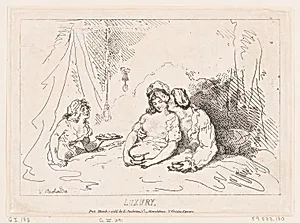
Luxury
March 7, 1786
Medium
Etching
Dimensions
Sheet: 6 7/8 × 9 1/2 in. (17.5 × 24.2 cm)
Classification
Prints
Department
Drawings and Prints
Museum
Metropolitan Museum of Art, New York, NY
Credit
The Elisha Whittelsey Collection, The Elisha Whittelsey Fund, 1959
Accession Number
59.533.180
Rights
Public Domain
Tags
Art Historical Context
Created in 1786 by British artist Thomas Rowlandson and published by Elizabeth Jackson, *Luxury* is a lively etching that captures the playful pointed spirit of Georgian-era social satire. Rowlandson, celebrated for his witty caricatures of everyday life, explored themes of indulgence and human folly through scenes populated by couples, lovers, and attendants. Here, the composition highlights contrasts between opulence and everyday service, featuring female figures in intimate settings alongside male companions and servants. As an etching—a medium prized for its sharp lines and ability to reach wide audiences through affordable prints—this work reflects the vibrant print culture of late-eighteenth-century London. Rowlandson’s fluid drawing style and humorous eye made complex social commentary accessible, inviting viewers to reflect on the excesses of luxury amid a rapidly changing society. Acquired by the Metropolitan Museum of Art through the Elisha Whittelsey Collection, the print remains a delightful window into the era’s tastes and tensions. Its modest size (roughly 6 7/8 by 9 1/2 inches) belies the lively narrative it unfolds, reminding us how art could both entertain and gently critique the world it portrayed.
About the Artist
Thomas Rowlandson|Elizabeth Jackson · 1756–1827
Thomas Rowlandson (1757–1827) was an English artist and caricaturist whose satirical watercolors and prints captured the social life of Georgian Britain with unparalleled wit and technical mastery. Alongside James Gillray, he is recognized as one of the greatest British graphic artists, and his distinctive flowing line and keen observations have made his work integral to understanding late 18th an...