
Lydia and Berty
1921
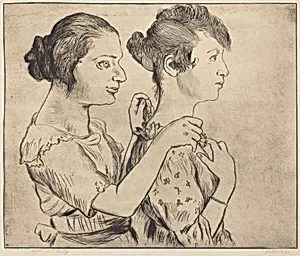
Medium
drypoint on wove paper [unique proof]
Dimensions
plate: 33.5 x 40.2 cm (13 3/16 x 15 13/16 in.) sheet: 36.5 x 48 cm (14 3/8 x 18 7/8 in.)
Classification
Department
CG-W
Museum
National Gallery of Art, Washington, D.C.
Credit
Ailsa Mellon Bruce Fund
Accession Number
2001.10.1
Rights
Public Domain
Art Historical Context
**Lydia and Berty** a striking drypoint print by German artist Karl Hubbuch 1921, during the turbulent early years of the Weimar Republic Hubbuch, a key figure in the New Objectivity movement (Ne Sachlichkeit), captured everyday subjects with unflinching realism subtle satire, reacting against the emotional excesses of Expressionism. This proof on wove paper—measuring 33.5 x 40.2 cm on the plate—depicts the titular figures in intimate, candid detail, reflecting the era's social flux amid post-World War I recovery. Drypoint, Hubbuch's chosen technique, involves scratching directly into a metal plate, producing the burr that yields richly textured, velvety lines with a spontaneous, painterly quality. As a one-of-a-kind impression rather than part of an edition, this work stands out for its rarity and the artist's direct handiwork, emphasizing his experimental printmaking prowess. Acquired through the Ailsa Mellon Bruce Fund, it resides in the National Gallery of Art's print collection. In the cultural landscape of 1920s Germany, Hubbuch's art often probed urban life, gender dynamics, and human vulnerability, making **Lydia and Berty** a poignant snapshot of modernity's complexities. Visitors will appreciate its technical finesse and historical resonance, inviting closer inspection of its intricate lines and evocative narrative.