
Medium
Classification
Department
Smithsonian Collection
Museum
Smithsonian American Art Museum
Credit
National Portrait Gallery, Smithsonian Institution; gift of Mr. and Mrs. Paul Mellon
Accession Number
S/NPG.74.39.7.8
Rights
Public Domain
Tags
Art Historical Context
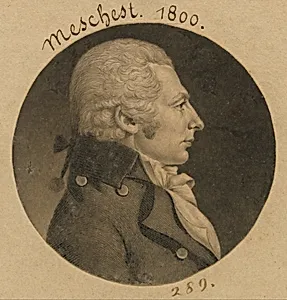
Step into the early days of the American republic with *M. A. Meschert*, a striking 1800 print by French-born artist Charles Balthazar Julien Févret de Saintémin (1770–1852). Capturing the profile of its male subject, this portrait exemplifies Saint-Mémin's innovative work after emigrating to Philadelphia in 1793 amid the French Revolution. There, he documented the faces of America's emerging elite, blending European finesse with New World ambition. Saint-Mémin pioneered the physiognotrace, a mechanical tracing device that produced precise profile silhouettes, which he then engraved onto copper plates for printing. This print medium—affordable and reproducible—made high-quality likenesses accessible beyond the wealthy, revolutionizing portraiture in a young nation hungry for self-representation. The oval format and meticulous detail highlight his neoclassical style, emphasizing dignity and character. Housed in the Smithsonian American Art Museum (gift of Mr. and Mrs. Paul Mellon), this piece from the National Portrait Gallery collection offers a window into 1800s social history. Who was M. A. Meschert? Likely a figure of local note, his image endures as a testament to Saint-Mémin's legacy of over 900 portraits, preserving the human stories of Federal-era America.