
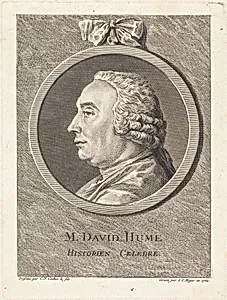
M. David Hume
Medium
engraving on laid paper [second state]
Dimensions
plate: 19.4 x 14.5 cm (7 5/8 x 5 11/16 in.) sheet: 23.1 x 17.4 cm (9 1/8 x 6 7/8 in.)
Classification
Department
CG-E
Museum
National Gallery of Art, Washington, D.C.
Credit
Gift of John O'Brien
Accession Number
1990.56.3
Rights
Public Domain
Art Historical Context
This 1764 engraving presents a portrait of the Scottish philosopher David Hume, a leading figure of the Enlightenment whose writings on reason, human nature, and skepticism influenced generations of thinkers. Created by Simon Charles Miger after a design by the esteemed French draftsman Charles-Nicolas Cochin II, the print captures Hume at the height of his intellectual career. As an engraving on laid paper, it belongs to a tradition of reproductive prints that made portraits of notable individuals accessible beyond the elite circles who could afford original paintings or drawings. The second state of the print reflects the careful refinement typical of 18th-century engraving techniques, where artists used fine lines and subtle tonal variations to convey texture and personality. Such works played an important cultural role in circulating ideas and images across Europe, helping to shape public recognition of philosophers, writers, and statesmen during a period of vibrant intellectual exchange. Measuring just under eight by six inches in the plate, this modest yet elegant print now resides in the National Gallery of Art thanks to a generous gift, offering today’s visitors a tangible connection to both Hume’s era and the skilled printmaking practices that preserved his likeness for posterity.