
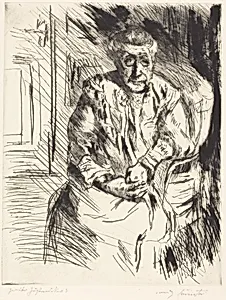
Ma Belle Mere (Mother-in-Law)
1919
Medium
drypoint in black
Dimensions
plate: 33.1 x 25 cm (13 1/16 x 9 13/16 in.) sheet: 47.4 x 33.4 cm (18 11/16 x 13 1/8 in.)
Classification
Department
CG-W
Museum
National Gallery of Art, Washington, D.C.
Credit
Rosenwald Collection
Accession Number
1947.7.22
Rights
Public Domain
Art Historical Context
Lovis Corinth's *Ma Belle Mere (Mother-in-Law)*, created in 1919, is a striking drypoint print that captures the artist's late-career mastery of expressive portraiture. By this time, Corinth, a leading figure in German Expressionism and key member of the Berlin Secession, had evolved from Impressionist influences toward bolder, more psychological depth, especially after his 1911 stroke. This intimate portrait, likely of his mother-in-law, reflects the turbulent post-World War I era in Germany, where personal subjects often conveyed emotional resilience amid societal upheaval. The drypoint technique—scratching directly into a copper plate to produce rich, velvety burr lines—lends the work its tactile intensity. Printed in black ink on a modest plate (33.1 x 25 cm), the image's soft edges and dramatic contrasts highlight Corinth's skill in rendering texture and character with minimal means. Drypoint's fugitive burr, which wears down after few impressions, underscores the edition's rarity and the medium's appeal for spontaneous, painterly effects. Housed in the National Gallery of Art's Rosenwald Collection, this print exemplifies Corinth's innovative printmaking, bridging painting and graphics. Visitors will appreciate its candid gaze, inviting reflection on family bonds and the human spirit in trying times.
About the Artist
Lovis Corinth · 1858–1925
Lovis Corinth, born Franz Heinrich Louis on July 21, 1858, in Tapiau, East Prussia (now Gvardeysk, Russia), to a tanner father, displayed prodigious drawing talent from childhood. He began formal training at the Königsberg Academy in 1876, then moved to the Academy of Fine Arts in Munich from 1880 to 1884, studying under Ludwig von Löfftz and briefly Franz von Defregger, where he absorbed a Realis...