
Maan
1822
Medium
nishikie, with metallic pigments and blindprinting
Dimensions
206; 181
Rights
Public Domain
About this artwork
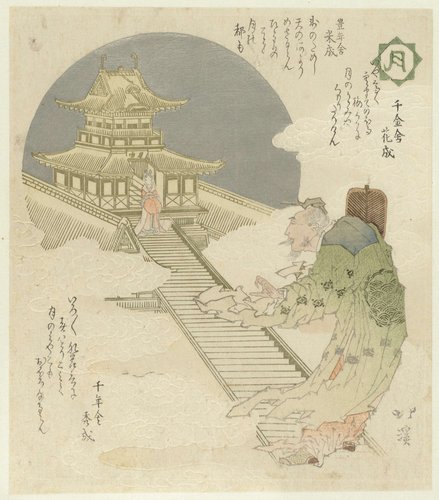
Een oude man met een waaier in zijn rechter hand, staat onderaan een lange trap. Bovenaan de trap staat een dame voor een paviljoen. De man is de Chinese keizer Gensô (Hsüang Tsung, 685-762) en de vrouw zijn favoriete bijvrouw Yôkihi (Yang Kuei-fei, 719-56). Hier is hun ontmoeting in het hiernamaals afgebeeld; Yôkihi werd namelijk geexecuteerd nadat zij en haar familie te veel macht kregen. Meet drie gedichten.
Art Historical Context
**Maan** (1822) by Totoya Hokkei a exquisite *nishikie* woodblock, a hallmark of Japan's Edo-period ukiyo-e tradition. Measuring just 206 × 181 mm, this surimono-style work captures a poignant afterlife reunion between Chinese Emperor Xuanzong (ensô, r. 685–762) and his beloved concubine Yang Guife (Yôkihi, 719–756). At the base of a towering staircase, the aged emperor clutches a fan, gazing up at the elegant lady before a pavilion—a symbol of their tragic love story, where Yôkihi's execution amid political intrigue severed their earthly bond. Hokkei, a skilled pupil in the ukiyo-e school, masterfully employs advanced techniques like metallic pigments for shimmering highlights and blindprinting (*karazuri*) to create textured, embossed effects that evoke ethereal depth and luxury. These methods elevate the print beyond mere illustration, making it a tactile treasure often produced for poetic New Year's exchanges. The composition frames three inscribed poems, blending visual narrative with literary elegance. This artwork reflects Japan's fascination with Chinese romantic legends, immortalized in tales of passion and downfall during the An Lushan Rebellion. Hokkei's delicate rendering invites visitors to ponder themes of longing and reunion, showcasing how ukiyo-e bridged history, poetry, and artistry in 19th-century Japan.
About the Artist
Totoya Hokkei · 1780–1850
Totoya Hokkei (魚屋 北渓, 1780–1850), born Iwakubo Tatsuyuki in Edo (modern Tokyo), began his life as a humble fishmonger in the Yotsuya Samegahashi district, a trade reflected in his art name "Totoya," meaning fish shop. He transitioned to art through rigorous training, first studying under Kanō Yōsen'in Korenobu, head of the Kobikichō branch of the prestigious Kanō school, where he honed landscape p...