
Mace head
Unknown Artist
ca. 4500–2900 BCE
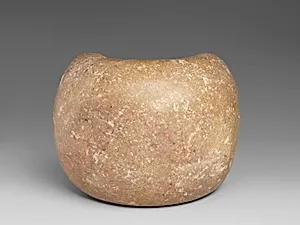
Medium
Stone
Dimensions
2.52 in. (6.4 cm)
Classification
Stone-Implements
Culture & Period
Iran · Chalcolithic–Early Bronze Age
Department
Ancient Near Eastern Art
Museum
Metropolitan Museum of Art, New York, NY
Credit
Rogers Fund, 1938
Accession Number
38.40.364
Rights
Public Domain
Art Historical Context
This petite stone mace head,ailing from ancient Iran during the Chalcolithic to Early Bronze Age (ca 4500–2900 BCE), offers a window into a pivotal era of human innovation. Measuring just 2.52 inches (6.4 cm) in diameter, it exemplifies the enduring use of stone implements as societies transitioned from purely stone-based tools to early metallurgy. Crafted from durable stone, its compact form suggests it was hafted onto a wooden handle, transforming it into a formidable weapon. In the Ancient Near East, particularly in regions like modern-day Iran, mace heads like this one were more than mere tools—they symbolized power and status. Artisans demonstrated remarkable skill in shaping and polishing hard stone, achieving a smooth, functional surface ideal for combat or ceremonial use. This period marked cultural advancements, including early urbanization at sites like Tepe Sialk, where such artifacts were common grave goods for elites. Today, acquired through the Rogers Fund in 1938, this mace head resides in the Metropolitan Museum of Art's Department of Ancient Near Eastern Art. It invites us to ponder the daily lives and conflicts of our distant ancestors, reminding us how simple stone could wield great influence.