
Mace head
Unknown Artist
ca. 9th century BCE
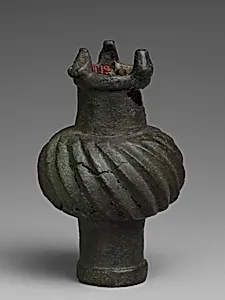
Medium
Bronze
Dimensions
3 1/16 × 1 7/8 × 1 7/8 in. (7.7 × 4.8 × 4.8 cm)
Classification
Metalwork-Implements
Culture & Period
Iran · Iron Age II, Hasanlu Period IV
Department
Ancient Near Eastern Art
Museum
Metropolitan Museum of Art, New York, NY
Credit
Purchase, Mrs. Constantine Sidamon-Eristoff Gift, 1961
Accession Number
61.100.18
Rights
Public Domain
Art Historical Context
This bronze mace head dating to around the 9th century BCE, hails from ancient Iran during the Iron Age II and Hasanlu Period IV. a compact 3 1/16 × 1 7/8 × 1 7/8 inches, it exemplifies the practical yet skillfully crafted metalwork of the Ancient Near East. As a weapon component, it would have been fitted onto a wooden handle to deliver powerful, crushing blows in combat, reflecting the martial priorities of Iron Age societies in northwestern Iran. The choice of bronze—a durable alloy of copper and tin—highlights advanced casting techniques prevalent in the region. Artisans at sites like Hasanlu, a key archaeological hub, produced such implements with precision, balancing functionality and portability. These mace heads often served dual roles as tools of war and symbols of status, underscoring the interconnected worlds of craftsmanship and conflict. Today, this artifact graces the Metropolitan Museum of Art's Ancient Near Eastern Art collection, acquired through a 1961 purchase and gift. It offers visitors a tangible link to the vibrant, turbulent cultures of prehistoric Iran, inviting reflection on how everyday objects shaped ancient lives.