
Mace head
Unknown Artist
ca. 9th century BCE
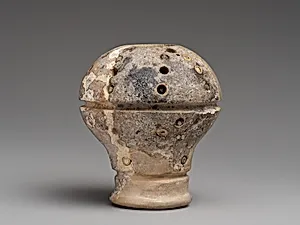
Medium
Limestone, gold
Dimensions
2 11/16 × 2 7/16 × 2 7/16 in. (6.9 × 6.2 × 6.2 cm)
Classification
Stone-Implements
Culture & Period
Iran · Iron Age II, Hasanlu Period IV
Department
Ancient Near Eastern Art
Museum
Metropolitan Museum of Art, New York, NY
Credit
Rogers Fund, 1965
Accession Number
65.163.48
Rights
Public Domain
Art Historical Context
This exquisite limestone mace head, dating to around the 9th century BCE, hails from Iran during the Iron Age II, specifically the Hasanlu Period IV Measuring just under three inches across, it exemplifies the masterful stoneworking of the Ancient Near East. Crafted from durable limestone and adorned with gold, its compact, spherical form was designed to fit atop a wooden handle, it into a formidable weapon or symbol of power. Unearthed from the ruins of Hasanlu—a thriving settlement in northwestern Iran—this artifact sheds light on a turbulent era of warrior elites and intricate craftsmanship. The use of gold alongside everyday limestone highlights the object's prestige, likely belonging to a chieftain or high-ranking figure. Such mace heads were not mere tools of war; their luxurious materials suggest ceremonial roles in rituals or as status symbols, reflecting the cultural fusion of utility and opulence in Iron Age societies. Today, housed in the Metropolitan Museum of Art's Department of Ancient Near Eastern Art (acquired via the Rogers Fund in 1965), this mace head invites us to ponder the lives of its makers—skilled artisans who blended functionality with artistry amid a world of conflict and conquest.