
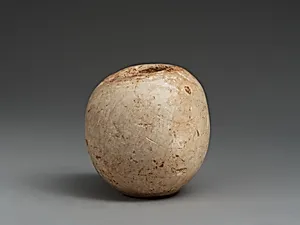
Mace head
Unknown Artist
7th–6th millennium BCE
Medium
Stone, tan
Dimensions
2.17 in. (5.51 cm)
Classification
Stone-Implements
Period
Neolithic
Department
Ancient Near Eastern Art
Museum
Metropolitan Museum of Art, New York, NY
Credit
Gift of Sheldon and Barbara Breitbart, 1985
Accession Number
1985.356.25
Rights
Public Domain
Art Historical Context
Step back 9,000 years to the Neolithic period in the Ancient Near East, where this compact tan stone mace head (2.17 in. or 5.51 cm) was crafted by an unknown artist around the 7th–6th millennium. Housed in the Metropolitan Museum of Art Department of Ancient Near Eastern Art, this artifact—classified as a stone implement and a gift from Sheldon and Barbara Breit in 1985—offers a tangible glimpse into humanity's early technological ingenuity. During the Neolithic era, communities in regions like the Levant transitioned from nomadic hunting to settled farming, fostering innovations in tool-making. Mace heads like this one were meticulously shaped from durable stone, likely hafted onto wooden handles to serve as effective weapons for hunting, defense, or even ceremonial display. Its small size suggests portability and precision craftsmanship, highlighting the period's growing mastery over hard materials without metal tools. This unassuming object underscores the cultural shift toward organized societies, where such implements symbolized strength and status. Though simple, its survival speaks volumes about the resilience of early human endeavors, inviting us to ponder the hands that shaped it millennia ago.