
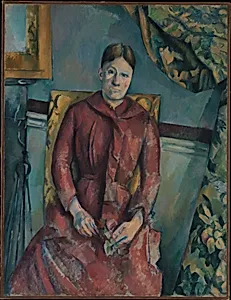
Madame Cézanne (Hortense Fiquet, 1850–1922) in a Red Dress
1888–90
Medium
Oil on canvas
Dimensions
45 7/8 × 35 1/4 in. (116.5 × 89.5 cm)
Classification
Paintings
Department
European Paintings
Museum
Metropolitan Museum of Art, New York, NY
Credit
The Mr. and Mrs. Henry Ittleson Jr. Purchase Fund, 1962
Accession Number
62.45
Rights
Public Domain
Tags
Art Historical Context
In the late 1880s, Paul Cézanne captured his wife, Hortense Fiquet, the vibrant *Madame Cézanne in a Red Dress*, painted between 1888 and 1890. This oil on canvas portrait, measuring nearly four feet tall, exemplifies Cézanne's Post-Impressionist style, where he moved beyond Impressionism's light effects to prioritize geometric structure and solid form. Hortense, seated confidently against a patterned wallpaper, dominates the composition her bold red gown, a color that draws the eye and underscores her presence. Cézanne's technique here reveals his revolutionary approach: deliberate, blocky brushstrokes build volume and depth, treating the canvas like a sculptural surface. He painted Hortense numerous times throughout their life together, using these portraits to explore the human figure's underlying architecture—a method that influenced modern masters like Picasso and Braque. The red dress, with its rich folds, adds a touch of intimacy and modernity to the otherwise contemplative mood. Housed in the Metropolitan Museum of Art's European Paintings department since 1962, this work invites visitors to appreciate Cézanne's bridge between 19th-century tradition and 20th-century abstraction, celebrating the everyday elegance of a woman who was both muse and partner.
About the Artist
Paul Cézanne · 1839–1906
Paul Cézanne (1839-1906) stands as one of the most influential figures in the history of modern art, often called the "Father of Modern Art" for his revolutionary approach to form, color, and pictorial space. Born in Aix-en-Provence to a wealthy banker who discouraged artistic pursuits, Cézanne rejected a legal career to pursue painting, though he remained financially dependent on his family until...