
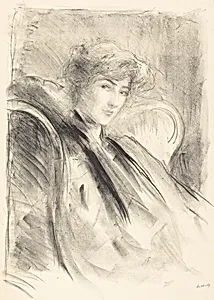
Madame Mejant
Medium
crayon lithograph in black on wove paper
Dimensions
plate: 47.8 x 31.7 cm (18 13/16 x 12 1/2 in.) sheet: 56 x 38.1 cm (22 1/16 x 15 in.)
Classification
Department
CG-W
Museum
National Gallery of Art, Washington, D.C.
Credit
Gift of George and Olga Kenney
Accession Number
1993.72.5
Rights
Public Domain
Art Historical Context
Albert Belleroche’s *Madame Mejant* (1906) captures the refined elegance of early twentieth-century portraiture through the subtle textures of crayon lithography. Created on wove paper with a black ink, the print measures nearly 48 by 32 centimeters in the plate area, allowing the artist to explore delicate tonal gradations and soft modeling that mimic the spontaneity of drawing while achieving the precision of printmaking. Lithography, especially the crayon technique Belleroche employed, was prized during this period for its ability to reproduce the immediacy of an artist’s hand at a time when original works were often accessible only to collectors. By working directly on the stone with greasy crayons, Belleroche could create velvety blacks and fine lines that lend a sense of intimacy to the subject, inviting viewers to appreciate both the sitter’s presence and the medium’s expressive potential. As a gift to the National Gallery of Art, this work exemplifies how prints helped broaden public engagement with contemporary art in the Edwardian era. Its restrained yet evocative style highlights lithography’s role in bridging fine art and wider audiences, offering a quiet window into the social and artistic currents of 1906.