
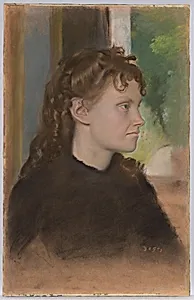
Madame Théodore Gobillard (Yves Morisot)
1869
Medium
Pastel
Dimensions
18 7/8 × 11 13/16 in. (48 × 30 cm)
Classification
Drawings
Department
Drawings and Prints
Museum
Metropolitan Museum of Art, New York, NY
Credit
Bequest of Joan Whitney Payson, 1975
Accession Number
1976.201.8
Rights
Public Domain
Tags
Art Historical Context
Edgar Degas's *Madame Théodore GobillardYves Morisot)*, created in 1869, the poised profile of a woman from the Morisot family close friends and associates of the artist. At just 18 7/8 × 11 13/16 inches, this intimate pastel portrait exemplifies Degas's early mastery of modern portraiture, shifting from classical themes toward everyday subjects. Rendered during a pivotal time when Degas was forging ties with fellow innovators like the Morisots—linked to Impressionism through Berthe Morisot—it reflects the social circles of Paris's cultural elite. Executed in pastel, a medium Degas would later champion for its vibrant, luminous effects, the work showcases his precise linework and subtle color layering, evoking a sense of quiet elegance. The profile view, a nod to classical antiquity yet infused with contemporary realism, highlights the subject's graceful features against a softly modulated background, emphasizing psychological depth over flattery. Now housed in the Metropolitan Museum of Art's Drawings and Prints department, thanks to the 1975 bequest of Joan Whitney Payson, this piece offers visitors a glimpse into Degas's evolving style on the cusp of Impressionism, blending technical virtuosity with personal connection.
About the Artist
Edgar Degas · 1834–1917
Edgar Degas (1834-1917) stands as one of the most innovative artists of the nineteenth century, whose distinctive vision transformed how modern life could be depicted on canvas. Born Hilaire-Germain-Edgar De Gas in Paris to a wealthy banking family—his father French, his mother a Louisiana Creole from New Orleans—Degas received a classical education before abandoning law studies in 1855 to pursue ...