
Mademoiselle de Fitz-James
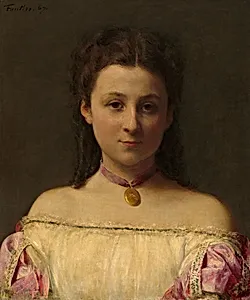
Medium
oil on canvas
Dimensions
overall: 51.1 x 42.8 cm (20 1/8 x 16 7/8 in.) framed: 75.9 x 68 cm (29 7/8 x 26 3/4 in.)
Classification
Painting
Department
CF
Museum
National Gallery of Art, Washington, D.C.
Credit
Chester Dale Collection
Accession Number
1963.10.24
Rights
Public Domain
Art Historical Context
Henri Fantin-Latour's *Mademoiselle de Fitz-J* (1867) is a captivating oil-on-canvas portrait that exemplifies the artist's mastery of 19th-century French Realism. Measuring 51.1 x 42.8 cm, this intimate work captures the poised elegance of its young aristocratic subject, likely a member of the noble Fitz-James family, the opulent Second Empire era in Paris. Fantin-Latour (1836–1904), a close associate of Édouard Manet and James McNeill Whistler, favored precise, luminous portraits that blended academic rigor with subtle psychological depth, distancing himself from the Impressionist trends of his time. Painted in oil on canvas—a medium ideal for Fantin-Latour's delicate glazes and velvety textures—the piece showcases his refined technique: soft, diffused lighting that enhances the sitter's porcelain skin and rich fabrics, evoking the grandeur of Haussmann's transforming Paris. This approach reflects Realism's emphasis on truthful observation over idealization, making the portrait both a personal likeness and a window into elite society. Now housed in the National Gallery of Art as part of the esteemed Chester Dale Collection, *Mademoiselle de Fitz-James* invites visitors to ponder the era's blend of formality and intimacy in portraiture, reminding us how art preserves fleeting moments of grace.
About the Artist
Henri Fantin-Latour · 1836–1904
Ignace Henri Jean Théodore Fantin-Latour was born on January 14, 1836, in Grenoble, France, to portrait painter Théodore Fantin-Latour, who gave him his earliest drawing lessons. The family relocated to Paris in 1841, where in 1850, at age 14, he enrolled in the École de Dessin, studying under Horace Lecoq de Boisbaudran, whose innovative memory-based method of drawing from observation profoundly ...