
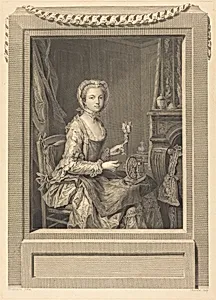
Mademoiselle Sa Soeur
1726 to 1750
Medium
engraving
Classification
Department
CG-E
Museum
National Gallery of Art, Washington, D.C.
Credit
Widener Collection
Accession Number
1942.9.2110
Rights
Public Domain
Art Historical Context
*Mademoiselle Sa Soeur* is an exquisite engraving by Juste Chevillet, after an original work by Jean-Gard Heilmann between 1726 and 1750. This print captures the elegance of 18th-century French Roc portraiture, a period celebrated for its playful, refined depictions of daily life and aristocracy. Heilmann, a German-born painter active in Paris, was renowned for his sensitive portraits and genre scenes, while Chev, a skilled engraver, faithfully translated the composition into intricate lines on a metal plate. Engraving, the medium here, was a revolutionary reproductive technique that allowed artworks to reach a broader audience beyond the elite. By incising fine lines into copper plates and inking them for printing, artists like Chevillet democratized visual culture, making Heilmann's charming portrayal—likely of a poised young woman, suggested by the title "Miss Her Sister"—accessible to collectors and admirers across Europe. Housed in the National Gallery of Art's Widener Collection, this piece exemplifies the technical mastery of Rococo printmaking and its role in preserving ephemeral portraits. Visitors will appreciate its delicate hatching and cross-hatching, which evoke the softness of Heilmann's brushwork, offering a window into the graceful world of pre-Revolutionary France.