
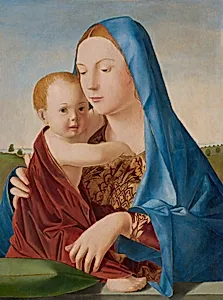
Madonna and Child
c. 1475
Medium
oil and tempera on panel transferred from panel
Dimensions
painted surface: 58.1 x 43.2 cm (22 7/8 x 17 in.) overall: 58.9 x 43.7 cm (23 3/16 x 17 3/16 in.) framed: 86.7 x 74.8 x 8.3 cm (34 1/8 x 29 7/16 x 3 1/4 in.)
Classification
Painting
Department
CIS-R
Museum
National Gallery of Art, Washington, D.C.
Credit
Andrew W. Mellon Collection
Accession Number
1937.1.30
Rights
Public Domain
Art Historical Context
Antonello da Messina’s *Madonna and Child* (c. 1475) presents the Virgin tenderly holding the infant Jesus against a dark background, a format that invites quiet contemplation. Created in the heart of the Italian Renaissance, the small panel was designed for private devotion, allowing viewers to connect intimately with the sacred figures. Its presence in the National Gallery of Art’s Andrew W. Mellon Collection underscores its enduring appeal as both a devotional object and a masterful painting. Antonello, a Sicilian artist active in the fifteenth century, was renowned for introducing Northern European oil-painting methods to Italy. Here he combines oil and tempera, achieving luminous skin tones, delicate folds in the Virgin’s mantle, and a striking sense of three-dimensional form. The meticulous rendering of textures and the subtle play of light reflect his study of Flemish masters while retaining the balanced composure characteristic of Italian Renaissance art. Though the panel was later transferred to a new support, the painting’s crisp details and harmonious composition remain remarkably preserved. Visitors can appreciate how Antonello’s innovative technique elevated a traditional subject, making the divine figures feel both approachable and profoundly human.