
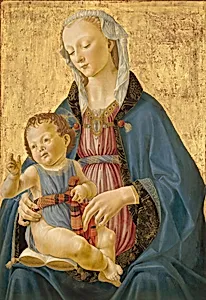
Madonna and Child
c. 1470/1475
Medium
tempera on panel transferred to hardboard
Dimensions
painted surface: 70.8 x 48.9 cm (27 7/8 x 19 1/4 in.) overall size: 73 x 50.2 cm (28 3/4 x 19 3/4 in.) framed: 115.6 x 89.2 x 7.6 cm (45 1/2 x 35 1/8 x 3 in.)
Classification
Painting
Department
CIS-R
Museum
National Gallery of Art, Washington, D.C.
Credit
Samuel H. Kress Collection
Accession Number
1961.9.49
Rights
Public Domain
Art Historical Context
Domenico Ghirlandaio's *Madonna and Child*, painted around 1470–1475, exemplifies the devotional art of early Renaissance Florence. Ghirlandaio, a fresco painter and teacher to Michelangelo, crafted this intimate tempera on panel in his characteristic style—marked by precise detail, lifelike figures, and a sense of realism. Tempera, made from pigments bound with egg yolk, allowed for the jewel-like colors and fine brushwork that bring the Virgin Mary's tender gaze and the Christ Child's gentle form to vivid life, a technique central to Italian panel painting before oil gained prominence. This work captures the era's deep religious fervor, where images of the Madonna and Child served as focal points for personal prayer in homes and chapels. Ghirlandaio's early career drew from Florentine predecessors like Verrocchio, blending Gothic grace with emerging Renaissance naturalism. At 70.8 x 48.9 cm, its modest scale suggests it was likely a private devotional piece, emphasizing quiet spirituality amid Florence's artistic boom. Now preserved through transfer to hardboard and housed in the National Gallery of Art as part of the Samuel H. Kress Collection, this painting offers a window into 15th-century piety and Ghirlandaio's skill, inviting visitors to ponder the enduring humanity in sacred subjects.