
Madonna and Child with Saints Francis and Jerome
1500–10
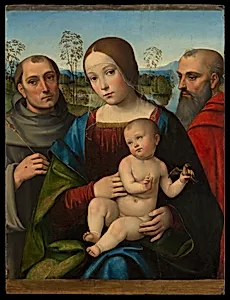
Medium
Tempera on wood
Dimensions
Overall 29 1/2 x 22 3/8 in. (74.9 x 56.8 cm); painted surface 27 1/2 x 22 1/4 in. (69.9 x 56.5 cm)
Classification
Paintings
Department
European Paintings
Museum
Metropolitan Museum of Art, New York, NY
Credit
Gift of George Blumenthal, 1941
Accession Number
41.100.3
Rights
Public Domain
Tags
Art Historical Context
Francesco Francia's *Madonna and Child Saints Francis and Jerome*, around 1500–1510, exemplifies the serene devotional art of Renaissance Bologna. Francia, a goldsmith-turned-painter active in northern Italy, drew inspiration from masters like Perugino, delicate Peruginesque grace with his own precise, jewel-like detail. This tempera-on-wood panel, a traditional medium using egg-based paint for luminous, enduring colors and fine brushwork, captures a classic *sacra conversazione*— "holy conversation" where the Virgin Mary cradles the Christ Child amid Saints Francis and Jerome in harmonious composure. The inclusion of Saint Francis, patron of animals and poverty, and Saint Jerome, the scholarly hermit with his lion, reflects popular Renaissance piety, inviting viewers into intimate spiritual reflection. Measuring nearly 30 by 22 inches, the work's intimate scale suited private devotion or chapel altarpieces. Its meticulous technique highlights Francia's goldsmith roots in intricate patterns and glowing halos, bridging Gothic finesse with emerging High Renaissance ideals. Now at the Metropolitan Museum of Art thanks to a 1941 gift from George Blumenthal, this painting offers a window into early 16th-century Italian faith and artistry, where beauty served the divine.
About the Artist
Francesco Francia · 1447–1517
Influential Bolognese painter of his period, noted for sweet, softly rounded Madonnas and portraits. Influenced by Costa, his partner, and by Perugino. Comment on works: Religious