
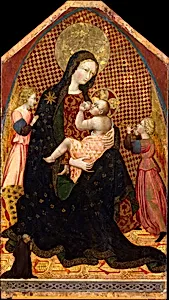
Madonna and Child with Two Angels and a Donor
Medium
Tempera on wood, gold ground (partly checkered with modern red glazes)
Dimensions
Shaped top: overall 57 1/8 x 32 in. (145.1 x 81.3 cm); painted surface 54 1/4 x 32 in. (137.8 x 81.3 cm)
Classification
Paintings
Department
European Paintings
Museum
Metropolitan Museum of Art, New York, NY
Credit
Bequest of George Blumenthal, 1941
Accession Number
41.190.16
Rights
Public Domain
Tags
Art Historical Context
Giovanni di Paolo di Grazia a leading Sienese painter of the early Renaissance (c. 1403–1482), created *Madonna and Child with Two Angels and a Donor* 1445. Thisa-on-wood panel, featuring a luminous gold ground partly checkered with modern redazes, exemplifies the International Gothic style blended with emerging Renaissance naturalism. Measuring over 57 inches tall with a shaped top, it was likely designed for private devotion or as part of altarpiece, a common format in 15th-century Italy where gold leaf evoked heavenly splendor and tempera's fine brushwork allowed intricate details. The composition centers the tender Madonna nursing the Christ Child, flanked by two angels and a kneeling male donor, reflecting deep Marian devotion widespread in Renaissance Tuscany. Giovanni di Paolo's signature style shines through in his elongated, graceful figures, vibrant colors, and whimsical details—hallmarks of Siena's artistic tradition influenced by predecessors like Simone Martini. The donor's portrait underscores the era's patronage culture, where wealthy commissioners sought spiritual intercession through such personalized images. Housed in the Metropolitan Museum of Art's European Paintings department (Bequest of George Blumenthal, 1941), this work highlights the cultural role of religious art in fostering piety and community identity, inviting viewers to contemplate divine nurture amid earthly life.