
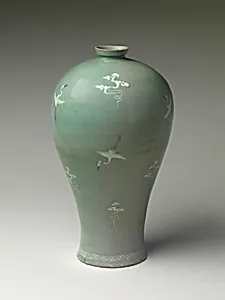
청자 상감 구름 학 무늬 매병 고려|靑磁象嵌雲鶴文梅甁 高麗|Maebyeong (plum bottle) decorated with cranes and clouds
Unknown Artist
second half 12th century
Medium
Stoneware with inlaid decoration under celadon glaze
Dimensions
H. 13 1/4 in. (33.7 cm); Diam. 7 1/2 in. (19.1 cm)
Classification
Ceramics
Culture & Period
Korea · Goryeo dynasty (918–1392)
Department
Asian Art
Museum
Metropolitan Museum of Art, New York, NY
Credit
Gift of Sadajiro Yamanaka, 1911
Accession Number
11.8.1
Rights
Public Domain
Tags
Art Historical Context
This elegant maebyeong, or plum bottle, was created during the Goryeo dynasty (918–1392) in the second half of the twelfth century, a period celebrated for the refined beauty of Korean ceramics. Standing 13¼ inches tall, the stoneware vessel features a graceful, rounded body that tapers elegantly toward the neck, a shape originally designed to hold blossoming plum branches. Its surface displays cranes soaring among stylized clouds, rendered through the sophisticated sanggam inlay technique in which white and black slips were carefully inserted into carved designs before the application of the signature celadon glaze. The luminous jade-green glaze, achieved through reduction firing, gives the piece its luminous, jade-like quality while protecting the delicate inlaid motifs. In Goryeo society, cranes symbolized longevity, fidelity, and auspicious fortune, making such imagery popular on objects intended for both daily use and ceremonial display. The unknown potter’s mastery of inlay and glaze reflects the high technical standards of Korean workshops, where celadon production reached its artistic peak. Acquired by the Metropolitan Museum of Art in 1911 as a gift from Sadajiro Yamanaka, this bottle offers visitors a window into the refined aesthetics and spiritual values of medieval Korea. Its harmonious blend of form, color, and symbolic decoration continues to exemplify the quiet elegance prized in Goryeo art.