
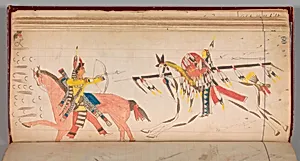
Maffet Ledger: Drawing
Unknown Artist
ca. 1874–81
Medium
Graphite, watercolor, and crayon on paper
Dimensions
H. 11 3/4 × W. 5 1/4 in. (29.8 × 13.3 cm)
Classification
Paper-Drawings
Culture
Southern and Northern Cheyenne
Department
Arts of Africa, Oceania, and the Americas
Museum
Metropolitan Museum of Art, New York, NY
Credit
The Michael C. Rockefeller Memorial Collection, Purchase, Nelson A. Rockefeller Gift, 1968
Accession Number
1978.412.207 (64)
Rights
Public Domain
Tags
Art Historical Context
In the late 19th century, and Northern Cheyenne artists created vivid ledger drawings like this one from the *Maffet Ledger* (ca. 1874–81), using readily available materials such as graphite, watercolor, crayon on paper. Depicting men on horseback wielding bows and arrows, the work captures the dynamic essence of Plains warrior life—hunting, raiding, and communal prowess—rendered in bold outlines and flat, symbolic colors typical of the genre. These small-scale pieces (11 3/4 × 5 1/4 in.) were often made in ledger books repurposed from traders' accounting pads, reflecting resourcefulness amid reservation confinement. Historically, this drawing emerged during a turbulent era following devastating conflicts like the Sand Creek Massacre (1864) and the Battle of Little Bighorn (1876), when Cheyenne peoples faced forced relocation and cultural suppression by the U.S. government. Ledger art served as a vital form of visual storytelling, preserving oral histories, personal exploits, and cultural pride in a time of transition from nomadic buffalo-hunting societies to settled life. Today, housed in The Metropolitan Museum of Art's Michael C. Rockefeller Memorial Collection, this anonymous masterpiece highlights the artistic ingenuity of Cheyenne creators. Its narrative power invites visitors to reflect on resilience, offering a poignant window into Indigenous perspectives often overlooked in mainstream histories.