
Maffet Ledger: Drawing
Unknown Artist
ca. 1874–81
Medium
Graphite, watercolor, and crayon on paper
Dimensions
H. 11 3/4 × W. 5 1/4 in. (29.8 × 13.3 cm)
Classification
Paper-Drawings
Culture
Southern and Northern Cheyenne
Department
Arts of Africa, Oceania, and the Americas
Museum
Metropolitan Museum of Art, New York, NY
Credit
The Michael C. Rockefeller Memorial Collection, Purchase, Nelson A. Rockefeller Gift, 1968
Accession Number
1978.412.207 (96)
Rights
Public Domain
Tags
Art Historical Context
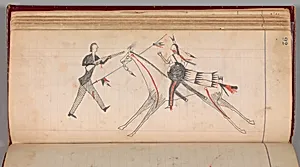
Step into the world of Southern and Northern Cheyenne with the *Maffet Ledger: Drawing*, by an unknown artist around 1874–81. This intimate work on paper, measuring just 11¾ × 5¼ inches, employs graphite, watercolor, and crayon to vividly capture scenes likely featuring horses, firearms, men, and womenhallmarks of Plains Indian ledger art. Produced during a turbulent era following the Indian Wars, these drawings repurposed everyday ledger paper from traders or agencies, transforming accounting sheets into powerful visual narratives. Ledger drawings like this one emerged in the late 19th century as Cheyenne people, confined to reservations after conflicts such as the Battle of the Little Bighorn, documented their pre-reservation lives. Warriors and artists used bold outlines, flat colors, and dynamic compositions to recount battles, hunts, and daily triumphs, blending traditional pictographic styles with introduced media. The crayon and watercolor add vibrant energy, while graphite provides precise detailing, making each figure and horse leap off the page. Housed in The Metropolitan Museum of Art's Arts of Africa, Oceania, and the Americas department, this piece from the Michael C. Rockefeller Memorial Collection offers a poignant window into Cheyenne resilience and cultural memory. It reminds us how art became a form of resistance and remembrance amid profound change.