
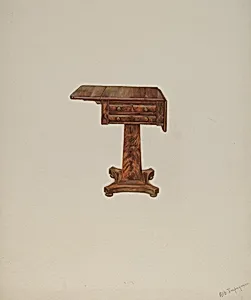
Mahogany Sewing Table
c. 1941
Medium
watercolor, colored pencil, and graphite on paper
Dimensions
overall: 47.6 x 37.8 cm (18 3/4 x 14 7/8 in.) Original IAD Object: 27"high; 16 x 16 1/2 in., top
Classification
Index of American Design
Department
CG-W
Museum
National Gallery of Art, Washington, D.C.
Credit
Index of American Design
Accession Number
1943.8.5715
Rights
Public Domain
Art Historical Context
Created around 1941 by artist Anne B. Trepagnier, *Mahogany Sewing Table* is a meticulous rendering from the Index of American Design (IAD), a Works Progress Administration (WPA) project during the Great Depression. This initiative employed artists to document America's rich heritage of folk art, crafts, and everyday objects through detailed watercolor studies, preserving cultural artifacts for future generations. Trepagnier's work captures a classic mahogany sewing table—standing 27 inches high with a 16 x 16½-inch top—evoking the refined domestic life of early American households. Rendered in watercolor, colored pencil, and graphite on paper (47.6 x 37.8 cm), the piece showcases the IAD's signature style: hyper-realistic depiction of wood grain, rich mahogany tones, and functional elegance. These mixed-media techniques allowed artists to convey texture, light, and subtle details with scientific precision, blending artistry with archival accuracy. Sewing tables like this one highlight 18th- and 19th-century craftsmanship, often central to women's sewing and homemaking rituals. Displayed at the National Gallery of Art, this artwork bridges fine art and design history, reminding us how ordinary furnishings embodied American ingenuity and tradition amid economic hardship. A testament to the WPA's legacy, it invites visitors to appreciate the beauty in the utilitarian.