
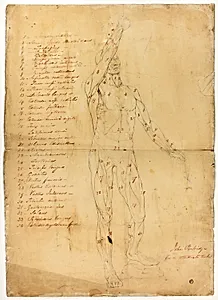
Male Ecorché
c. 1810
Medium
Black chalk, with red ink inscriptions, on cream wove paper, prepared with a reddish-brown wash
Dimensions
68 × 48.7 cm (26 13/16 × 19 3/16 in.)
Classification
pen and ink drawings
Department
Prints and Drawings
Museum
Art Institute of Chicago
Accession Number
3169
Rights
Public Domain
Art Historical Context
This striking anatomical study, known as *Male Écorché*, captures the human form in meticulous detail, with the skin removed to reveal the underlying musculature. Created around 1810 by British artist John Partridge, the drawing exemplifies the rigorous study of anatomy that formed a cornerstone of artistic training during the early nineteenth century. Such écorché figures helped artists master the body's structure, ensuring lifelike representations in paintings and sculptures. Partridge executed the work in black chalk on paper prepared with a reddish-brown wash, a technique that lends warmth and subtle tonal depth to the figure. Delicate red ink inscriptions likely label specific muscles, underscoring the drawing's educational purpose. At over two feet tall, the large scale invites close examination of every contour and tendon. Housed in the Art Institute of Chicago's Prints and Drawings department, this piece reflects the period's blend of scientific inquiry and artistic practice. It offers viewers a glimpse into how artists of the era bridged observation and imagination to bring the human body vividly to life on paper.