
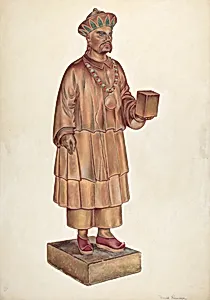
Male Tea Shop Figure
1937/1941
Medium
watercolor, gouache, and graphite on paperboard
Dimensions
overall: 71.5 x 50.9 cm (28 1/8 x 20 1/16 in.) Original IAD Object: 63" high; 16" wide
Classification
Index of American Design
Department
CG-W
Museum
National Gallery of Art, Washington, D.C.
Credit
Index of American Design
Accession Number
1943.8.7714
Rights
Public Domain
Art Historical Context
Created as part of the Index of American Design, a New Deal initiative of the 1930s and early 1940s, David Ramage’s rendering captures a striking 19th-century shop figure once used to advertise a tea merchant. Standing over five feet tall, the original carved wooden figure would have stood outside or inside a store, its bold scale and painted details serving as an eye-catching emblem of trade in an era before widespread commercial signage. Ramage worked in watercolor, gouache, and graphite on paperboard, layering translucent washes with opaque touches to record every contour, costume fold, and decorative flourish. This meticulous technique was essential to the Index project, which aimed to preserve visual records of American folk and decorative arts before they disappeared. The resulting image combines scientific accuracy with subtle artistic sensitivity, allowing viewers today to appreciate both the craftsman’s carving and the draftsman’s skill. Now housed in the National Gallery of Art, the work offers a vivid glimpse into everyday commercial culture of the past and the government-sponsored effort to celebrate it. Through Ramage’s careful documentation, a once-functional shop sign becomes a lasting testament to American design heritage.