
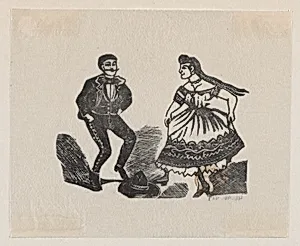
Man and woman dancing
ca 1890–1910
Medium
Zincograph
Dimensions
Sheet: 3 3/4 × 4 1/2 in. (9.5 × 11.5 cm)
Classification
Prints
Department
Drawings and Prints
Museum
Metropolitan Museum of Art, New York, NY
Credit
The Elisha Whittelsey Collection, The Elisha Whittelsey Fund, 1946
Accession Number
46.46.427
Rights
Public Domain
Tags
Art Historical Context
Created around 1890–1910, “Man and Woman Dancing” is a small zincograph by the celebrated Mexican printmakers José Guadalupe Posada and Manuel Manilla. Zincography, a technique that uses zinc plates to produce crisp, affordable images, allowed these artists to reach wide audiences through newspapers, broadsides, and popular flyers. Measuring just under four by five inches, this lively scene captures an ordinary couple mid-step, their figures rendered with the bold, economical lines typical of Posada and Manilla’s collaborative work. During Mexico’s turbulent transition from the Porfiriato into the revolutionary era, such prints served as both entertainment and subtle social commentary. Posada, in particular, became renowned for blending everyday moments with sharp observation, often infusing his imagery with humor or critique. Here, the simple joy of dance stands alongside the artists’ broader output of calaveras and satirical scenes, reminding viewers that popular art could document daily life as powerfully as grand paintings. Today, this delicate sheet in the Metropolitan Museum’s collection offers a window into the vibrant print culture that shaped modern Mexican visual identity. Its modest size and accessible medium underscore how Posada and Manilla turned everyday subjects into enduring symbols of Mexican resilience and creativity.
About the Artist
José Guadalupe Posada|Manuel Manilla · 1852–1913
José Guadalupe Posada (1852-1913) was a Mexican printmaker and engraver who revolutionized popular art and created some of the most iconic images in Mexican culture. Working primarily with publisher Antonio Vanegas Arroyo, he produced over 20,000 images during his career—inexpensive broadsheets sold for a penny on colored paper that made his art accessible to even the poorest workers. He transform...