
Man and Woman with Lanterns
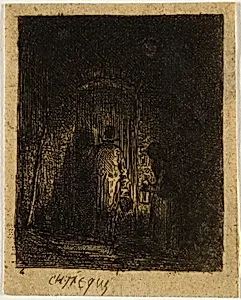
Medium
Etching on buff chine
Dimensions
Image: 4.8 × 3.9 cm (1 15/16 × 1 9/16 in.); Sheet: 5.6 × 4.5 cm (2 1/4 × 1 13/16 in.)
Classification
etching
Department
Prints and Drawings
Museum
Art Institute of Chicago
Accession Number
45937
Rights
Public Domain
Art Historical Context
Charles Émile Jacque's *Man and Woman with Lanterns* is a delicate etching on buffine paper, capturing an intimate nocturnal scene likely from rural French life. Created around the mid-19th century ( not specified), this tiny print—measuring just 4.8 × 3.9 cm—showcases Jacque's mastery of the etching technique, where acid etches intricate lines into a metal plate richly textured impressions. The buff chine, a thin, warm-toned paper imported from China, enhances the subtle glow of lantern light and earthy shadows, giving the work a luminous, almost painterly quality. Jacque, a key figure in the Barbizon School, specialized in realistic depictions of peasants, animals, and countryside scenes, bridging Romanticism and Realism. His prints often romanticized everyday rural existence, reflecting 19th-century fascination with pastoral simplicity amid France's industrial changes. This piece exemplifies his skill in evoking mood through fine lines and tonal variations, making it a gem for print enthusiasts. Housed in the Art Institute of Chicago's Prints and Drawings Department, *Man and Woman with Lanterns* invites close viewing under magnification, revealing Jacque's precise draftsmanship. Its diminutive scale underscores the artistry of 19th-century printmaking, where small works held immense expressive power for collectors and connoisseurs.