
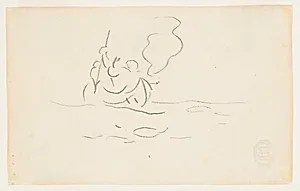
Man in a Canoe with Harpoon
Medium
landscapes
Classification
landscapes
Department
Smithsonian Collection
Museum
Smithsonian American Art Museum
Credit
Gift of Charles Savage Homer, Jr.
Accession Number
1912-12-231
Rights
Public Domain
About this artwork
Research in Progress
Art Historical Context
Winslow Homer’s 1897 work “Man in a Canoe with Harpoon” captures a solitary figure navigating open water, reflecting the artist’s lifelong fascination with humanity’s relationship to nature. An American painter active from the Civil War era through the turn of the twentieth century, Homer often turned to outdoor subjects in his later decades, favoring direct observation over studio invention. Classified here as a landscape, the piece aligns with his broader exploration of coastal and wilderness scenes that emphasize light, movement, and quiet tension. Created just thirteen years before Homer’s death, the painting entered the Smithsonian American Art Museum through a gift from the artist’s brother, Charles Savage Homer, Jr. This family provenance underscores the personal significance many of his late works held for those closest to him. As research on the piece continues, visitors can appreciate how Homer’s restrained palette and careful attention to the figure’s posture convey both the vastness of the environment and the individual’s focused determination within it.