
Man in Cap and Coat
Emanuel Gottlieb Leutze, 1852
About this artwork
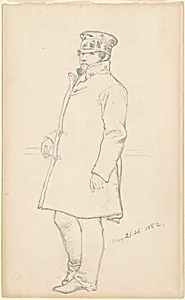
**Man in Cap and Coat** is a delicate graphite drawing on wove paper by Emanuel Gottlieb Leutze, created in 1852. Measuring just 9 3/8 × 5 3/4 inches, this intimate study captures a figure in everyday attire—a cap and coat—rendered with precise, economical lines. Leutze, a German-American painter renowned for his grand historical canvases like *Washington Crossing the Delaware* (1851), often turned to such sketches as preparatory work, honing his observation of light, texture, and form before scaling up to monumental scenes of American heroism. Graphite on wove paper was a favored medium for 19th-century artists like Leutze, offering versatility for quick, expressive studies. Wove paper's smooth surface allowed for subtle shading and fine detail, ideal for capturing the subtle folds of fabric and the character's poised demeanor. This piece reflects Leutze's Romantic interest in the individual amid historical narratives, bridging his European training with his embrace of American identity. Now part of the National Gallery of Art's Corcoran Collection, the drawing was a cherished gift from Leutze's son, Rear Admiral E.H.C. Leutze. It offers visitors a rare glimpse into the artist's personal process, contrasting his epic paintings with this quiet, human-scale portrait from the mid-19th century.