
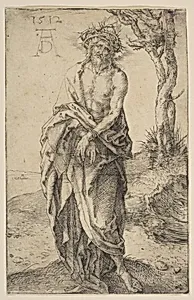
Man of Sorrows with Hands Bound
1512
Medium
Drypoint
Dimensions
plate: 4 9/16 x 2 15/16 in. (11.5 x 7.4 cm)
Classification
Prints
Department
Drawings and Prints
Museum
Metropolitan Museum of Art, New York, NY
Credit
Fletcher Fund, 1919
Accession Number
19.73.21
Rights
Public Domain
Tags
Art Historical Context
In the somber "Man of Sorrows with Bound," created by Albrecht Dürer 1512, we encounter a poignant depiction of Christ after his flagellation. Bound at the wrists and gazing mournfully outward, the figure embodies profound suffering and redemption—a classic "Man of Sorrows" motif medieval devotion that invited personal meditation on Christ's passion. Dürer, the preeminent Northern Renaissance printmaker from Nuremberg, produced this intimate work late in his career, amid his travels and deepening exploration of faith during the eve of the Protestant Reformation. Executed in drypoint, a demanding intaglio technique where the artist scratches directly into a copper plate with a sharp tool, this print (measuring just 4 9/16 x 2 15/16 inches) showcases Dürer's virtuosity. Unlike his famed engravings with precise burin lines, drypoint yields a soft, velvety texture from burrs raised by the needle, capturing the subtle tonal gradations of Christ's thorn-crowned face and bloodied torso. These small-scale drypoints were experimental treasures, often gifted to friends, blending technical innovation with emotional depth. Housed in the Metropolitan Museum of Art's Drawings and Prints department (acquired via the Fletcher Fund in 1919), this piece highlights Dürer's role in elevating prints to fine art, making profound religious imagery accessible beyond grand altarpieces. For visitors, it evokes the era's spiritual intensity, where art bridged the divine and the human.
About the Artist
Albrecht Dürer · 1471–1528
Albrecht Dürer (1471–1528) stands as the preeminent figure of the Northern Renaissance and arguably the most influential artist in the history of printmaking. Born in Nuremberg on May 21, 1471, and dying in the same city on April 6, 1528, Dürer revolutionized the status of the artist in Northern Europe, transforming printmaking from a commercial craft into an independent fine art and establishing ...