
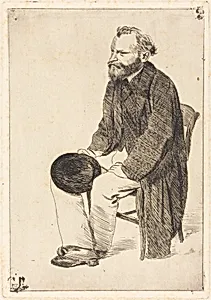
Manet Seated, Turned to the Left (Manet assis, tourné à gauche)
c. 1861
Medium
etching on wove paper
Dimensions
sheet: 31 x 22 cm (12 3/16 x 8 11/16 in.)
Classification
Department
CG-E
Museum
National Gallery of Art, Washington, D.C.
Credit
Rosenwald Collection
Accession Number
1950.1.52
Rights
Public Domain
Art Historical Context
This intimate etching by Edgar Degas captures his close friend and fellow artist Édouard Manet seated and turned slightly to the left. Created around 1861, early in both artists’ careers the print offers a personal glimpse into the vibrant Parisian art world of the 1860s, just before the Impressionist movement took shape. Degas, who would become renowned for his innovative compositions and interest in modern life, here pays tribute to Manet through a quiet, direct portrait that highlights their mutual respect and shared artistic circles. Executed in etching on wove paper, the work demonstrates Degas’s skillful use of line to convey form and character with economical means. Etching allowed artists of this period to produce subtle tonal effects and fine details, making it ideal for capturing the informal, spontaneous quality of a private moment. Measuring just 31 by 22 centimeters, the small scale enhances the sense of immediacy and closeness between artist and subject. As part of the National Gallery of Art’s Rosenwald Collection, this print stands as an important record of the friendships that fueled 19th-century French art. It reminds viewers how Degas and Manet helped redefine portraiture by embracing everyday subjects and experimental techniques that would later define Impressionism.
About the Artist
Edgar Degas · 1834–1917
Edgar Degas (1834-1917) stands as one of the most innovative artists of the nineteenth century, whose distinctive vision transformed how modern life could be depicted on canvas. Born Hilaire-Germain-Edgar De Gas in Paris to a wealthy banking family—his father French, his mother a Louisiana Creole from New Orleans—Degas received a classical education before abandoning law studies in 1855 to pursue ...