
Manjuvajra Mandala
Unknown Artist
11th century
Medium
Black stone
Dimensions
H. 46 in. (116.8 cm); W. 24 in. (61 cm); D. 7 1/2 in. (19.1 cm)
Classification
Sculpture
Culture & Period
Bangladesh or India (Bengal) · Pala period
Department
Asian Art
Museum
Metropolitan Museum of Art, New York, NY
Credit
Bequest of Cora Timken Burnett, 1956
Accession Number
57.51.6
Rights
Public Domain
Tags
Art Historical Context
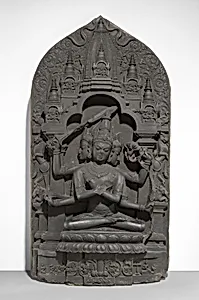
This striking 11th-century black stone sculpture *Manjuvajra Mandala*, hails from the Pala period in Bengal (modern-day Bangladesh or eastern India), a golden era for Buddhist art. Carved from a single block of dark stone, it stands an impressive 46 inches tall, depicting the tantric deity Manjuvra—a fierce, multi-armed form of the bodhisattva Manjushri, wisdom's embodiment. Surrounding the central figure are attendant bodhisattvas, stup, and symbolic swords, evoking a three-dimensional mandala that serves as a meditative map of the cosmos. In Pala workshops, artisans excelled in rendering intricate details on hard stone, using fine chisels to capture dynamic poses, flowing garments, and esoteric iconography central to Vajrayana Buddhism. This sculpture reflects the period's flourishing tantric traditions, where such images aided practitioners in visualizing enlightenment amid the Bengal region's vibrant monastic culture. Now at the Metropolitan Museum of Art through the bequest of Cora Timken Burnett in 1956, it invites visitors to ponder the fusion of devotion and artistry in medieval South Asia, where stone became a portal to the divine.