
Man's Linen Collar
c. 1937
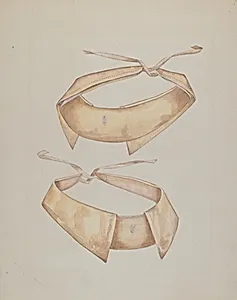
Medium
watercolor, graphite, and gouache on paper
Dimensions
overall: 35.7 x 28 cm (14 1/16 x 11 in.) Original IAD Object: 7 1/2" long; 2" wide; band: 15" long
Classification
Index of American Design
Department
CG-W
Museum
National Gallery of Art, Washington, D.C.
Credit
Index of American Design
Accession Number
1943.8.1177
Rights
Public Domain
Art Historical Context
Visitors to the National Gallery of Art encounter *Man's Linen Collar*, a meticulous 1937 rendering by artist Verna Tallman, capturing the crisp elegance of a traditional American accessory. Created as part of the Index of American Design (IAD a Federal Art Project initiative during the Great Depression, watercolor, graphite, and gouache on paper (35.7 x 28 cm) documents a linen collar measuring 7½ inches long, 2 inches wide, a 15-inch band. Tallman's precise depiction highlights the collar's starched folds and delicate fabric texture, evoking the formal menswear of earlier American eras. The IAD, launched in 1935 under the Works Progress Administration, employed artists like Tallman to preserve vanishing folk and decorative arts through detailed illustrations. This piece exemplifies the project's mission to celebrate everyday American craftsmanship amid economic hardship, safeguarding cultural heritage for future generations. Gouache provided opaque vibrancy for whites and linens, while graphite added fine lines, blending scientific accuracy with artistic flair. Today, *Man's Linen Collar* reminds us of fashion's role in identity and status, offering a window into bygone tailoring traditions rendered with Depression-era ingenuity. (198 words)
About the Artist
Verna Tallman · 1855–present
Verna Tallman remains a figure about whom the historical record has preserved very little. No birth or death dates have been established, and her nationality and training are not documented in major reference sources. The works attributed to her suggest an engagement with decorative or illustrative traditions, though without more contextual documentation it is difficult to place her within a spec...