
Mantle
Unknown Artist
10th–15th century
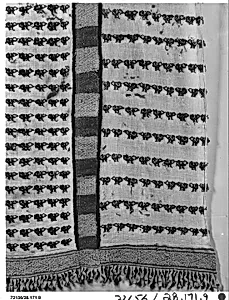
Medium
Camelid hair, cotton
Dimensions
Overall: 34 x 77 in. (86.36 x 195.58 cm) Other: 34 in. (86.36 cm)
Classification
Textiles-Woven
Culture
Peru; central coast (?)
Department
Arts of Africa, Oceania, and the Americas
Museum
Metropolitan Museum of Art, New York, NY
Credit
Rogers Fund, 1928
Accession Number
28.171.9
Rights
Public Domain
Art Historical Context
This magnificent mantle, woven on Peru's central coast(?) between the 10th and 15th centuries, exemplifies the extraordinary textile artistry of pre-Colian Andean cultures. Spanning the Late Intermediate Period, it likely served as a ceremonial garment or shroud, reflecting the society's reverence for finely crafted cloth as a marker of status and spirituality. Measuring an impressive 34 x 77 inches, its generous size suggests it draped over the body or was used in rituals, evoking the vibrant world of ancient Peruvians who mastered weaving long before European contact. Crafted from camelid hair—sourced from llamas or alpacas—and cotton, the mantle highlights innovative fiber blending for durability, warmth, and subtle sheen. Andean weavers employed complex loom techniques, often creating intricate patterns (though specifics here are preserved in the weave's structure). Cotton provided a fine warp, while camelid fibers offered rich dye absorption, making textiles a primary canvas for storytelling and cosmology. Housed in The Metropolitan Museum of Art's Department of the Arts of Africa, Oceania, and the Americas (acquired via Rogers Fund, 1928), this piece underscores textiles' pivotal role in Peruvian heritage—more valued than gold in some contexts. Visitors, imagine wrapping yourself in history's threads!