
ManTou Gu (馒头 鼓)
19th century
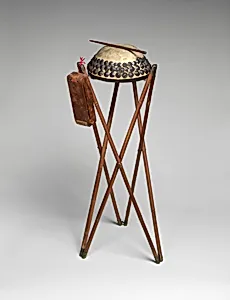
Medium
Wood, leather, various materials
Dimensions
Tripod (open): H. 30 x D. 10 x W. 10 in.(75.6.2 x 25.4 x 25.4 cm) Drum: Diam. 10 x H. 4 1/8 in. ( 25.4 x 10.4 cm)
Classification
Membranophone-single-headed / kettle drum
Culture
Chinese
Department
Musical Instruments
Museum
Metropolitan Museum of Art, New York, NY
Credit
The Crosby Brown Collection of Musical Instruments, 1889
Accession Number
89.4.33a, b
Rights
Public Domain
Art Historical Context
This 19th-century Chinese kettle drum, known as the Mantou Gu or “steamed bun drum,” showcases the inventive spirit of traditional instrument makers. Its distinctive rounded body, crafted from wood and covered with leather, evokes the shape of a popular steamed bun, giving the instrument both visual charm and acoustic warmth. Produced by the Golden Tone Workshop, the drum rests on an elegant tripod stand that allows it to be played at a comfortable height, highlighting the careful attention to both form and function typical of Qing-dynasty craftsmanship. Classified as a single-headed membranophone, the Mantou Gu belongs to a family of Chinese percussion instruments used in theater, processions, and court music. Its compact size—roughly ten inches in diameter—made it versatile for small ensembles, while the taut leather head produced a resonant, focused tone. The name itself reflects a delightful cultural habit of linking musical objects to everyday foods, underscoring how art and daily life intertwined in Chinese society. Acquired by the Metropolitan Museum in 1889 as part of the Crosby Brown Collection, this drum offers visitors a tangible link to centuries of Chinese musical tradition and the skilled workshops that sustained it.