
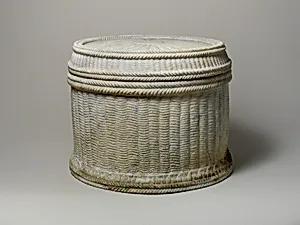
Marble cinerary urn with lid
Unknown Artist
ca. 10 BCE–10 CE
Medium
Marble
Dimensions
H. 9 11/16 in. (24.6 cm) diameter 12 7/16 in. (31.6 cm)
Classification
Stone Sculpture
Culture & Period
Roman · Early Imperial
Department
Greek and Roman Art
Museum
Metropolitan Museum of Art, New York, NY
Credit
Gift of Mrs. Frederick E. Guest, 1937
Accession Number
37.129a, b
Rights
Public Domain
Tags
Art Historical Context
This elegant marble cinerary urn with lid, dating to the Early Imperial Roman period (ca. 10 BCE–10 CE), served as a vessel for cremated ashes, reflecting the widespread Roman practice of cremation during the late Republic and early Empire. Standing just under 10 inches tall with a 12-inch diameter, its compact size suggests it was designed for personal or household use likely honoring a loved one in a domestic shrine or columbarium. Crafted from fine marble—a prized material for its durability and luminous quality—this urn exemplifies the Roman mastery of stone sculpture, where artisans skillfully carved vessels to evoke permanence amid mortality. In the context of Augustus' reign, when Rome transitioned into a vast empire, such urns symbolized continuity and reverence for the dead, often placed in family tombs or niches. The anonymous craftsmanship highlights the era's workshop traditions, where skilled sculptors produced functional yet refined objects blending utility with subtle artistry. Though undecorated details are sparse, the urn's smooth, polished surfaces would have gleamed in funerary settings, underscoring marble's role in immortalizing memory. Today, this poignant artifact graces the Metropolitan Museum of Art's Greek and Roman Art department, a gift from Mrs. Frederick E. Guest in 1937, inviting visitors to ponder ancient Roman views on life, death, and legacy.