
Marble Decorative Panels
Unknown Artist
10th–11th century
Medium
Marble
Dimensions
Overall: 27 1/2 x 33 1/2 x 1 1/8 in. (69.9 x 85.1 x 2.9 cm)
Classification
Sculpture-Architectural
Culture
Byzantine
Department
Medieval Art
Museum
Metropolitan Museum of Art, New York, NY
Credit
Fletcher Fund, 1947
Accession Number
47.100.46
Rights
Public Domain
Art Historical Context
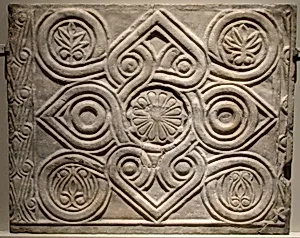
These exquisite Marble Decorative Panels, by an unknown artist in the10th–11th, hail from the Byzantine Empire during its Middle Byzantine period—a golden age of artistic splendor centered in Constantinople. Measuring 27½ x 33½ x 1⅛ inches, these architectural sculptures were likely designed to adorn the interiors of churches, palaces, or sacred spaces, where marble revetment panels transformed plain walls into shimmering displays of imperial and divine luxury. Byzantine artisans prized marble for its durability and luminous quality, quarried from ancient Roman sources and carved with precise incisions to create subtle patterns that caught the light in candlelit sanctuaries. The panels exemplify Byzantine sculpture's shift toward refined, abstract decoration over figural narrative, emphasizing geometric motifs, crosses, or floral elements that symbolized eternity and the heavens. This technique not only highlighted the empire's mastery of stonework—often polished to a high sheen—but also served a theological purpose, evoking the heavenly Jerusalem described in scripture. Their presence in the Metropolitan Museum of Art's Medieval Art department, acquired through the Fletcher Fund in 1947, offers visitors a tangible link to Byzantium's enduring influence on Islamic, Romanesque, and Renaissance art. Fun fact: Such panels were so coveted that they were frequently recycled from earlier structures, blending antiquity with medieval innovation in a single slab.