
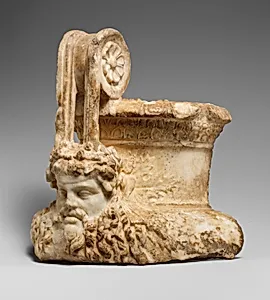
Marble fragment of a volute krater
Unknown Artist
1st–2nd century CE
Medium
Marble
Dimensions
H. 11 1/4 in. (28.5 cm)
Classification
Stone Sculpture
Culture & Period
Roman · Imperial
Department
Greek and Roman Art
Museum
Metropolitan Museum of Art, New York, NY
Credit
Purchase, David L. Klein Jr. Memorial Foundation Inc. and Nicholas S. Zoullas Gifts, 1997
Accession Number
1997.111
Rights
Public Domain
Tags
Art Historical Context
This exquisite marble fragment from a volute krater, to the 1st–2nd century CE, a glimpse into the opulent world of Roman Imperial art.ute kraters were grand Greek vase forms with distinctive spiral handles, originally used for mixing wine at symposia. By the Roman era, elite craftsmen transformed these into luxurious marble sculptures, blending Hellenistic traditions with imperial grandeur. Standing at 11¼ inches (28.5 cm) high, this piece—now in the Metropolitan Museum of Art's Greek and Roman Art Departmentsurvives as a testament to such high-end tableware prized by the Roman aristocracy. The fragment likely features finely carved heads, including that of Dionysus, the god of wine and revelry (known to Romans as Bacchus). Dionysus's presence evokes the joyous, ritualistic banquets central to Roman social life, where such vessels symbolized abundance and divine favor. Marble's durability and luminous quality allowed sculptors to achieve lifelike textures—flowing hair, expressive features—through precise chiseling and polishing techniques, hallmarks of Imperial stonework influenced by Greek prototypes. Though incomplete, this purchase from 1997 highlights the Met's commitment to preserving Roman cultural heritage, inviting us to imagine its role in a lavish triclinium, brimming with the echoes of ancient festivities.