
Marble funerary altar
Unknown Artist
1st half of 1st century CE
Medium
marble
Dimensions
H: 34 x W: 29 x D: 20 in. (86.3 x 73.7 x 51cm)
Classification
Stone Sculpture
Culture & Period
Roman · Early Imperial, Julio-Claudian
Department
Greek and Roman Art
Museum
Metropolitan Museum of Art, New York, NY
Credit
Gift of Lewis, Elaine, Jacob, Rachel, Ezra, and Joseph Dubroff, in celebration of the Museum’s 150th Anniversary, 2018
Accession Number
2018.838
Rights
Public Domain
Tags
About this artwork
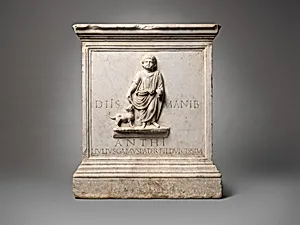
This Roman marble funerary altar from the first half of the first century CE embodies the commemorative practices and social values of the Early Imperial Julio-Claudian period. Prior to the second century, Romans typically cremated their dead and placed remains in marble ash chests or ash altars, or erected grave altars not designed to hold cremated remains. Such altars featured epitaph inscriptions that typically opened with a dedication to the manes (spirits of the dead) and closed with words ...
Art Historical Context
This exquisite marble funerary altar, crafted by an unknown Roman artist in the first half of 1st century CE, stands as a poignant relic of Early Imperial Julio-Claudian. Measuring 34 x 29 x 20 inches, it was designed for cremated remains or as a grave marker, reflecting the era's shift toward elaborate commemoration. Adorned with carved reliefs of snakes, boys, dogs birds, and trees— often evoking protection, the afterlife, and domestic life—it exemplifies the blend of practicality and artistry in Roman death rituals. Before the 2nd century, Romans favored cremation, housing ashes in such altars or chests inscribed with epitaphs honoring the *manes* (spirits of the dead) and praising the deceased. This early example is rare, as most date to the late 1st and early 2nd centuries. Commissioned mainly by prosperous freedmen and their middle-class descendants—teachers, architects, and musicians—these monuments often memorialized young children, underscoring the profound grief in Roman families. The costly marble and skilled carving signaled social status and devotion. A generous gift to the Metropolitan Museum of Art in 2018, this altar reveals how Romans invested in eternity: marking graves, preserving memories, and affirming cultural values of family and legacy. It invites us to reflect on the timeless human need to honor the lost.