
Marble funerary relief
Unknown Artist
2nd–3rd century CE
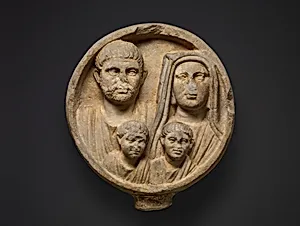
Medium
Marble
Dimensions
H.: 25 1/4 in. (64.1 cm) Other: 23 in. (58.4 cm)
Classification
Stone Sculpture
Culture & Period
Roman · Imperial
Department
Greek and Roman Art
Museum
Metropolitan Museum of Art, New York, NY
Credit
Fletcher Fund, 1949
Accession Number
49.69.5
Rights
Public Domain
Tags
Art Historical Context
This exquisite marble funerary relief, crafted by an unknown artist during the Roman Imperial period (2nd–3rd century CE), offers a poignant glimpse into ancient Roman family life and commemoration practices. Measuring about 25 inches high and 23 inches wide, it likely depicts a group including boys, men, and women—possibly a multigenerational family portrait carved to honor the deceased on a tomb monument. Such reliefs were common in Roman cemeteries, serving as eternal tributes that blended portraiture with symbolic elements to ensure the memory of loved ones endured. Historically, these sculptures reflect the Roman emphasis on *memoria*, where public displays of ancestry and social status affirmed one's place in society even after death. The Imperial era saw a fusion of Greek realism with Roman individualism, resulting in detailed, lifelike figures that captured personal traits and relationships. Marble, prized for its durability and luminous quality, was a prestigious choice, often sourced from quarries like those in Carrara, allowing for intricate high-relief carving that brought scenes to vivid life. Acquired through the Fletcher Fund in 1949 and housed in the Metropolitan Museum of Art's Greek and Roman Art department, this relief invites us to reflect on universal themes of loss and legacy, bridging the ancient world with our own.