
Marble Lentoid
Unknown Artist
ca. 1450–1375 BCE
Medium
Marble
Dimensions
Diam.: 3/4 in. (2 cm)
Classification
Gems
Culture & Period
Minoan · Late Minoan II–IIIA
Department
Greek and Roman Art
Museum
Metropolitan Museum of Art, New York, NY
Credit
Bequest of Richard B. Seager, 1926
Accession Number
26.31.240
Rights
Public Domain
Tags
Art Historical Context
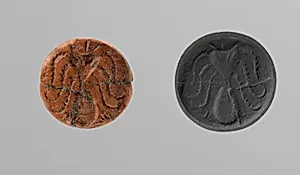
This exquisite Marble Lentoid, dating to the Late Minoan II–IA period (ca. 1450–1375 BCE), is a tiny gem from the vibrant Minoan culture of Crete. Carved from smooth marble and measuring just 3/4 inch (2 cm) in diameter, its lentil-shaped, biconvex form is characteristic of Minoan seals—personal stamps used to impress designs into clay or wax for sealing documents, goods, or containers. Though the specific engraving is not detailed here, such seals often featured intricate motifs like animals, plants, or hieroglyphs, reflecting the Minoans' mastery of miniature carving. In the bustling palace societies of Knossos and Phaistos, these seals played a vital role in administration and trade, underscoring the Minoans' advanced bureaucracy long before the Classical Greek era. Crafted during a time of cultural peak before the volcanic eruption on Thera and Mycenaean influences, this artifact offers a glimpse into a seafaring civilization celebrated for its frescoes, pottery, and thalassocracy (sea power). Bequeathed to the Metropolitan Museum of Art in 1926 by archaeologist Richard B. Seager, who excavated Minoan sites, this lentoid bridges us to Bronze Age Crete. Hold it up to the light, and imagine the hands that once pressed it into soft clay, securing treasures across the Aegean.