
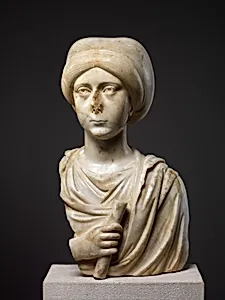
Marble Portrait Bust of a Woman with a Scroll
Unknown Artist
late 4th–early 5th century
Medium
Pentelic Marble
Dimensions
Overall: 20 7/8 x 10 13/16 x 8 3/4 in. (53 x 27.5 x 22.2 cm) Base: 1 7/8 x 12 1/2 x 6 3/4in. (4.8 x 31.8 x 17.1cm)
Classification
Sculpture-Stone
Culture
Byzantine
Department
The Cloisters
Museum
Metropolitan Museum of Art, New York, NY
Credit
The Cloisters Collection, 1966
Accession Number
66.25
Rights
Public Domain
Tags
Art Historical Context
This exquisite Marble Portrait Bust of a Woman with a, carved from fine Pentelic marble in the late 4th to early 5th century, captures refined elegance of early Byzantine portraiture. Housed in The Cloisters at the Metropolitan Museum of Art, the bust measures about 21 inches tall and depicts a poised woman holding a scroll, her features rendered with subtle realism and poise. Pentelic marble, sourced from quarries near Athens famed for the Parthenon, was prized for its bright white color and translucency, sculptors to achieve lifelike textures in hair, drapery, and skin. Dating to the transition from the late Roman to early Byzantine era, this sculpture reflects a cultural shift toward Christianity in the Eastern Roman Empire. Portrait busts like this honored elite individuals, often in domestic or commemorative settings, blending classical Greek-Roman traditions with emerging Byzantine austerity. The scroll she holds may symbolize learning, authority, or sacred texts, underscoring women's roles in an increasingly literate, faith-centered society. As part of The Cloisters Collection since 1966, this anonymous masterpiece invites us to ponder the anonymous sitter's story—a testament to the enduring artistry of Byzantine stone sculpture and its bridge between antiquity and the medieval world.