
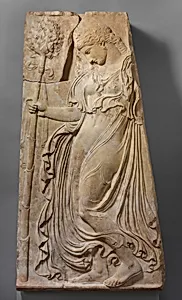
Marble relief with a dancing maenad
ca. 27 BCE–14 CE
Medium
Marble, Pentelic
Dimensions
H. 56 5/16 in. (143 cm)
Classification
Stone Sculpture
Culture & Period
Roman · Early Imperial, Augustan
Department
Greek and Roman Art
Museum
Metropolitan Museum of Art, New York, NY
Credit
Fletcher Fund, 1935
Accession Number
35.11.3
Rights
Public Domain
Tags
Art Historical Context
This exquisite marble relief, titled *Marble Relief with a Dancing Maenad* attributed to the sculptor Kallimachos, dates to the Early Imperial Augustan period (. 27 BCE–14 CE). Carved from fine Pentelic marble—a prized white stone quarried near Athens and favored for its luminous translucency—this 56-inch-high (143 cm) sculpture captures a maenad, one of the ecstatic female followers of the god Dionysus (Bacchus to the Romans), mid-dance. Her swirling drapery and dynamic pose evoke the wild, ritualistic revelry of Bacchic cults, blending grace with abandon. Created during Augustus's reign, when Rome celebrated its cultural renaissance by emulating classical Greek art, this relief exemplifies the Augustan era's neoclassical revival. Kallimachos, known for his elegant and refined style, infuses the work with intricate detailing: the maenad's flowing garments cling and billow realistically, showcasing masterful relief carving techniques that create depth and movement on a flat surface. Such sculptures adorned elite Roman villas, symbolizing the joys (and controlled chaos) of mythological life amid the emperor's push for moral renewal. Today, housed in the Metropolitan Museum of Art's Greek and Roman Art department (acquired via the Fletcher Fund in 1935), it invites visitors to ponder ancient women's roles in ecstatic worship—fierce, liberated figures whose energy transcends time. A testament to Roman artistry's debt to Greece, it pulses with timeless vitality.