
Marble Room
Late 19th century
Medium
Albumen print, stereo
Dimensions
Each image: 7.8 × 7.5 cm (3 1/8 × 3 in.); Card: 8.9 × 17.8 cm (3 9/16 × 7 1/16 in.)
Classification
photography
Department
Photography and Media
Museum
Art Institute of Chicago
Accession Number
198678
Rights
Public Domain
Art Historical Context
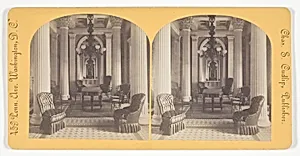
Step into the opulent "Marble Room," a captivating late 19th-century stereograph by photographer Chas. S. Cudlip. Captured as an albumen—a technique using egg white to create richly toned images on paper—this work presents paired 7.8 × 7.5 cm views mounted on an 8.9 × 17.8 cm card. Viewed through a stereoscope, the dual images merge into a vivid three-dimensional scene, immersing viewers in the room's lavish marble architecture, likely an interior from a grand public or institutional space. Stereographs like this one exploded in popularity during the Victorian era, offering affordable "virtual travel" to exotic or elite locales before widespread personal photography. Cudlip, active in commercial stereoview production, exemplified the era's blend of documentary precision and artistic illusion, using albumen for its sharp detail and warm sepia hues that enhanced the marble's luster and depth. Housed in the Art Institute of Chicago's Photography and Media department, "Marble Room" highlights photography's role in democratizing architecture and design. It invites us to ponder how 19th-century viewers marveled at such splendor, bridging everyday curiosity with cultural heritage. (198 words)