
Marble stele (grave marker) of a man
Unknown Artist
ca. 375–350 BCE
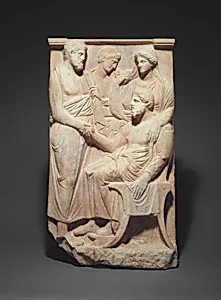
Medium
Marble
Dimensions
Overall: 56 x 32 x 8 in. (142.3 x 81.3 x 20.3 cm)
Classification
Stone Sculpture
Culture & Period
Greek, Attic · Late Classical
Department
Greek and Roman Art
Museum
Metropolitan Museum of Art, New York, NY
Credit
Fletcher Fund, 1959
Accession Number
59.11.27
Rights
Public Domain
Tags
Art Historical Context
This striking marble stele, dating to around 375–350 BCE, served as a grave marker for a man in ancient Attic Greece during the Late Classical period.ved from fine marble, it stands an impressive 56 x 32 x 8 inches, a size that allowed it to be prominently displayed in the Kerameikos cemetery outside Athens. Such stelai were common funerary monuments, offering a dignified tribute to the deceased amid the democratic city's emphasis on personal legacy. The relief sculpture likely depicts the man alongside family members—possibly women, as suggested by contemporary examples—capturing an intimate moment of farewell or daily life. Artisans employed high-relief techniques, blending Archaic rigidity with emerging Classical naturalism: soft drapery folds, subtle gestures, and expressive faces that evoke quiet emotion. This evolution reflects Athens' cultural flourishing post-Peloponnesian War, when simpler, heartfelt memorials replaced earlier grandeur after a brief ban on lavish tombs. Housed in the Metropolitan Museum of Art through the Fletcher Fund (1959), this anonymous masterpiece illuminates Attic values of family, piety, and restraint. It invites us to ponder the universal grief of loss across millennia, a timeless window into ancient Greek humanity.